A Smarter Way to Manage Hotel & Resort Billing
A practical guide to hotel and resort billing and accounting — multi-service folios, GST by tariff band, and why clean records earn you better credit, investment, and strategy. Includes a free KAI file for a resort to edit and make your own.


A single guest folio at a hotel or resort can carry four or five different kinds of revenue at once — the room itself, food and beverage, spa or wellness services, a banquet hall booking, maybe a laundry or transport charge. Each of those is a different line of business with its own tax treatment, and the room tariff alone doesn't sit at one flat rate — it moves in bands depending on what the guest actually pays per night. Most small and mid-sized properties still handle this the same way they did a decade ago: a front-desk register, a spreadsheet the accountant reconciles at month-end, and a certain amount of hoping nothing was missed.
That approach doesn't just create compliance risk. It quietly costs the business money and options — the two things most owners actually care about.
The problem hiding inside a single guest folio
When four revenue streams get bundled onto one invoice by hand, two things go wrong over time. First, tax treatment gets flattened — someone applies one rate across the whole folio because separating it correctly is tedious, and that's exactly the kind of inconsistency that surfaces in an audit. Second, and less obviously, the business loses visibility into which part of the property is actually making money. A resort can have excellent room occupancy and a quietly loss-making banquet operation, and a folio-level view will never show you that — only a books-level view, split correctly by revenue center, will.
Why your books are worth more than compliance
Clean, consolidated financial records are not just a filing obligation. They are the single asset that determines what a hospitality business can do next.
A bank evaluating a working-capital loan or a renovation line of credit wants to see consistent, reconciled revenue by category over multiple seasons — not a folder of invoices. An investor doing due diligence on a resort will discount the valuation, sometimes heavily, if the historical financials can't be trusted at a glance. And an owner trying to decide whether to add rooms, renegotiate a banquet contract, or invest in the spa is making that call blind without clean, comparable numbers across seasons.
What good hotel accounting practice actually looks like
The properties that get this right tend to share a few habits, regardless of size:
- Revenue centers stay separate in the books, even when they're billed on one folio at checkout — room, F&B, spa, and banquet each get their own line in the ledger, not just on the invoice.
- Reconciliation happens daily, not monthly — matching front-desk records against the books while the details are still fresh catches errors while they're still cheap to fix.
- Occupancy and revenue are tracked together, not in separate spreadsheets — the moment you can see revenue per available room next to your actual costs, pricing decisions stop being guesswork.
- GST treatment is reviewed periodically, not set once and forgotten — rate structures for hospitality have changed before and will again, and last year's assumption baked into a template is a liability.
Where purpose-built software actually changes the equation
None of the habits above require complicated software — they require a system that doesn't make correct behavior the hard path. Generic billing tools built for a single-product retail business tend to fail hospitality exactly here: they either force every service onto one flat rate, or they make splitting a folio correctly by GST rate such a manual chore that, in practice, nobody does it consistently.
This is the specific gap KAI was built to close for wellness and hospitality-adjacent businesses. It handles a multi-service folio as what it actually is — several revenue lines with their own GST treatment, reconciled into one clean record — and it builds the dashboards, occupancy trends, and GST reports directly from those real transactions, not from a manual month-end aggregation.
Experience it yourself — a hotel & resort file, ready to customize
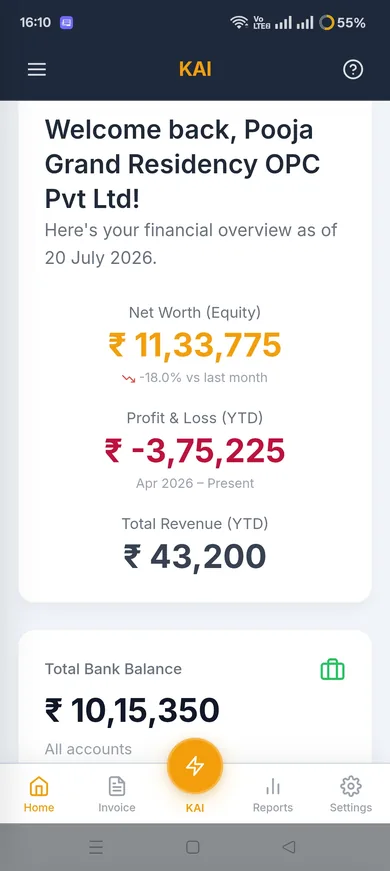
Rather than describe the interface, it's faster to just show you. Below is a KAI file built for a resort — a season of folios with GST handled correctly by service line, and a dashboard built from those transactions. Download it to experience KAI hands-on: edit it into your own property's data as a head start, or use it purely to learn how KAI is structured before building your own fresh.
Set it up in two minutes
- In KAI, go to Settings.
- Choose Backup & Restore, then Restore from File.
- Select the file you downloaded below.
- Enter the passphrase shown below when prompted.
Restore passphrase: 0000
This is fictional starter data, not a real business — edit it into your own, or use it purely to learn KAI's structure before building yours fresh.
Where to go from here
If multi-service, multi-rate billing is the problem you actually have, the KAI product page covers the full feature set. Related reading: running inventory-heavy billing well, managing recurring, batch-based revenue.
Found this useful?
Talk to us about your project